AdUnit3

Sunday, November 4, 2012

Khirsu - The Hidden Treasure of Pauri Gahrwal


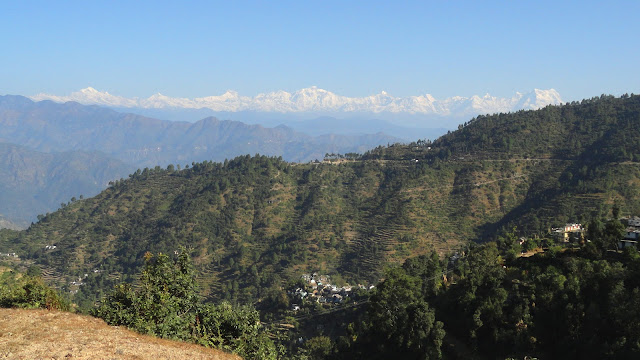
Himalayan range at Khirsu
Himalaya at Khirsu
Reaching Khirsu

I was with my better half, at Rishikesh government bus stand, and was looking for a direct bus to Khirsu, and to our surprise we found out many of the Gahrwalis haven’t even heard of the place. That made us even more interested on Khirsu. This means the sleepy little hamlet is still out of the normal tourist track, and is a must visit for people who really love nature and its silence.
Step farming Khirsu
There were no direct buses to Khirsu from Rishikesh, so we boarded a bus to Srinagar, from where Khirsu is another 31 kms. The driver had little care for the already rickety government bus, driving it nonchalantly over the sharp bends and deep potholes. The route was pretty scenic though, the hill slopes where covered with greenery and down the valley river Ganga was flowing languidly. We passed through Chandrapuri and Kaudiyala, where tented accommodation have been set up, on the riverbanks, for rafting buffs. We saw a few of them, rafting on the Ganges.Our extremely bumpy ride ended abruptly at maletha, 10 km before Srinagar, with a tyre puncture. Luckily we soon got a jeep and a driver who knew about Khirsu. He agreed to drop us at Khirsu, for a moderate 1200 rupees.
The road to Khirsu is absolute delight to the eyes; just after crossing Srinagar town, it bifurcates from the main road that goes to Rudraprayag. The road is really less travelled; we hardly saw any other vehicle on our way. We crawled our way uphill through terraced farming full of golden crops. There were sleepy little hamlets on the way, we saw villagers standing beside the road waiting for a hitchhike. We had some seats empty so picked couple of them till Khirsu.
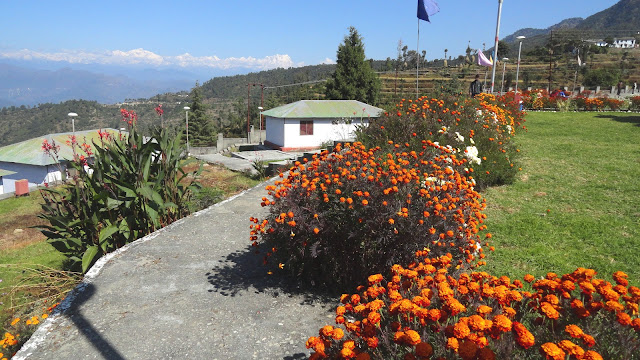
GMVN Khirsu compound
GMVN Khirsu Campus
Khirsu - The sorroundings and the impressive GMVN

It took us almost an hour and a half from Maletha, to reach the GMVN guest house at Khirsu. It is indeed the picture postcard mountain village everyone conjures up. A sleepy little hamlet, surrounded by forest and terraced farmlands, Khirsu is basically a cluster of 50 odd village houses and a government high school with a playground. The guest house is located at the highest hilltop in Khirsu giving a panoramic view of the entire village, and the majestic Himalayan snow peaks that dominates Khirsu’s skyline. Unfortunately the peaks were covered with clouds that time. But the surrounding countryside was beautiful nevertheless. The GMVN compound also has an impressive garden, with colourful flowers which added a touch of vibrancy to the entire landscape.
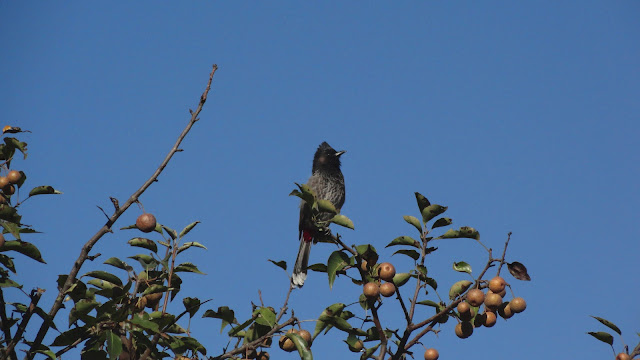
Birding at Khirsu
Birding at Khirsu
Khirsu - A Birding Paradise

Khirsu is a birding paradise. In fact the silence of Khirsu is only accentuated by the occasional chirping of mountain birds. On the afternoon we just rambled around the forested slopes near Khirsu, spotting a lot of species like white cheeked bulbul, yellow vented bulbul, laughing thrush, collared treepie and a few unknown one as well.
Expecting to spot a few more of them, we then decided to have a stroll on the forested road that goes to Pauri. The road to Pauri was absolutely surreal; it was thickly wooded and was looking mysterious on the fading afternoon light. The occasional tweets of unknown bird made it even more interesting.  We saw an oriental white eye on the woods. 

Suddenly on a curve we saw a bit of Chaukhamba, peeping through the foliage. We decided to return back to GMVN to have a better view. Just before sunset we could reach GMVN. Most of the peaks were still covered with clouds but we got a brief look of Chaukhamba and Mt Kedarnath. It was late October, so evening set in early. The nights were chilly enough to make us huddle inside our warm quilt. All we were waiting for was a clear sky, and next morning, we got that!    
Chaukhamba from Khirsu
Himalayan Splendor at Khirsu

The next morning Himalaya came out with all its grandeur. The sky was crystal clear, so we had a mesmerizing view of the entire range, starting from Chaukhamba at the right, then Kharchkund, Meru, Sumeru, mount Kedarnath, Brigupanth, Jaunli. At the extreme left Gangotri peak was also visible. Especially the view of Chaukhamba and Mt Kedarnath is massive at Khirsu. They look tantalizingly close. It just feels like this tiny little village is sleeping at the lap of mighty Chaukhamba.
Village Life Khirsu
Village Life Khirsu
We had nothing to do at Khirsu, except than rambling through the village paths and looking at the Himalayas in complete awe. We decided to walk downhill from the GMVN rest house to the village and have a glimpse of their village life. We found the men a bit laid back, most of them were either playing carom or cards, but the women were busy working in the fields or drying red chillies at their rooftop. We went to the high school ground, where students were having fun playing football. 

School Ground Khirsu
 After some aimless walk along the nooks and corners of the village, we came back to the rest house for a sumptuous lunch. The meal was very simple yet very tasty. We especially liked the sookha alu gobi, and Baigan bharta. The staffs were really cordial, and in spite of limited arrangements made us feel special with their hospitality.
 
A Short Trip to Pauri

After lunch we made a short trip to the Kyunkaleshwar Mahadev temple at Pauri. Pauri is half an hour drive from Khirsu. The road that goes from Khirsu to Pauri is absolutely breathtaking. The road goes through thick forest, and provides some gorgeous views of wooded valleys. There are couple of view points on that route and we got some enticing view of the himalayan forest from there.

Forest road in Khirsu
The Khirsu to Pauri road through thickly wooded hills
 Kyunkaleshwar Mahadev temple is at the highest hilltop at Pauri, 3 kms outside of Pauri town. The road to the temple goes through a dense pine forest and was very soothing to the eyes. From the base one has to climb around 100 steps to reach the hilltop temple. The stairs go through thick woods, and as usual the woods were full of birds. We saw a few yellow vented bulbul once again on the forest.

The main temple is old, and has an aura within it. The architecture reminded me of Jageshwar temple, of Kumayun. There were lot of devotees present, but still the place was peaceful, the chimes of prayer bell - reverberating on the hills was creating a divine atmosphere. We offered our prayers, had a look at the mighty Himalayas from the hilltop and decided to come back to Khirsu.

Last few hours at Khirsu..

After returning to Khirsu we decided to have some aimless walk on the vicinity. There are some lovely garhwali villages around Khirsu, and the traditional buildings on those villages are examples of typical Pahadi architecture. We went to one of those villages. The Pahadi houses looked enticing on the twilight.Wherever we went, we were greeted by the smiling face of Garhwali people.

  
Pahadi architecture
Pahadi Village Houses near Khirsu
If morning gave us a beautiful sunrise, the evening drew in with a colourful sunset. Fortunately, the snow capped Himalaya remained clear for the whole day, giving us a chance to see the sunset, paint its myriad hues on the silvery snow peaks. As soon as the evening drew in, Khirsu with its dark forests and rolling grey hills came up with its surreal best. 
Evening at Khirsu
Khirsu at the day's end
We enjoyed the day end from the GMVN lawn, sipping hot tea with onion pakora. As dusk was setting in at Khirsu, our sojourn at this beautiful mountain village was also coming to its end. It's a bliss for city dwellers like us to be able to experience such a peaceful lovely himalayan hamlet.. We relaxed rejuvenated and made a promise to ourselves, we will come back here soon!   

Travel Tips


  1. GMVN rest house is the best accomodation at Khirsu with a lovely compound.
  2. There's no direct bus to Khirsu from Rishikesh. Take a bus to Pauri, which takes around 5 hours and then book a cab for the last 19 kilometers for Khirsu.
  3. Pauri also provides some majestic view of himalayan range. However the view of Chaukhamba is excellent at Khirsu.
  4. For return journey come back to Pauri, and then take direct bus to Rishikesh or Haridwar.
  5. A short trip to Rudraprayag can also be taken, while staying at Khirsu.


Wednesday, April 18, 2012

Mukteshwar -The Gem of Kumaon


Peach Bloom at Mukteshwar
Towards Mukteshwar

The name Mukteshwar reminds me of the great Jim Corbett. After all it is the place where he was almost out thought by the wild man-eater. But the great Jim, eventually succeeded on killing the big cat, and then wrote his famous book – ‘Man Eaters of Kumaon’. Years have gone by, but thankfully, Mukteshwar with its forested hill slopes and sleepy serene atmosphere, have retained its old world charm.
I got the chance to visit Mukteshwar, this April, and was completely blown away by the beauty of the place.
The journey from Nainital to Mukteshwar is absolutely spellbinding. From Nainital we came down till Bhowali, and took the road that goes to Mukteshwar via Ramgarh. Soon after crossing Bhowali, the forest started. It was April, bloom time for the Rhododendrons. Every nook and corner of the forest was painted with the vibrant scarlet of Rhododendron.
Mukteshwar Rhododendron
Rhododendrons at Mukteshwar
The Apple Orchards of Ramgarh

Soon we reached Ramgarh, and from Ramgarh the scarlet rhododendron was replaced by the white apple flowers. Ramgarh is famous for its apple orchards. Each and every hill slope around Ramgarh was full of blooming apple tree. I tried to conjure up the scene, when couple of months later, those trees would be fully laden with red apples. It must have been some sight to behold.
Ramgarh Apple Orchards
Mukteshwar was another 25 kms from Ramgarh. We kept driving, leaving behind the blooming apple orchards, and once again moved into the forested hill slopes full of rhododendrons and reached there within an hour. We had our booking in KMVN, which is at the highest hilltop in Mukteshwar. The road to KMVN goes through the reserve forest maintained by IVRI, the sprawling forest with its age old pine and Deodar trees looked surreal.
IVRI forest Mukteshwar
IVRI reserve forest view from KMVN TRH
The location of KMVN Mukteshwar is absolutely brilliant. From the viewpoint one can see 390 kms of unobstructed Himalayan snow peaks, starting from Chaukhamba in Gahrwal range, the entire Kumaon range, and some snow peaks of Nepal Himalaya as well. But unfortunately the entire range was covered with clouds that day, so we could not get the view. But we kept our finger crossed for the next morning. The forested valley view and the view of layery hills from KMVN were nonetheless extremely refreshing.

View of Layery Hills from KMVN Mukteshwar
An afternoon well spent at Chauli ki Jali

On the afternoon we went for a short forest trek, towards the famous Chauli-Ki-Jali viewpoint. Once again we strolled through clumps of rhododendron. Chauli-Ki-Jali is really unique; the hilltop here is extremely rugged giving a completely different rocky look.
The mountains here have dropped almost vertically thousands of feet making it a great place for adventure sports. We could see some people trying their hand in rappelling. The view of the valley from the top was breathtakingly beautiful. The place is completely different from rest of Mukteshwar. While Mukteshwar is thickly wooded, the rugged world of Chauli Ki Jali provides a completely different perspective to the beauty of the hill station.
Chauli Ki Jali is also famous for its sunset. We stayed there till sunset, when the setting sun painted the sky with myriad hues, and as the valley below got draped with mist we returned to our cozy little KMVN guesthouse.

Chauli Ki jali drop
The rugged world of Chauli Ki Jali
Next Morning - Himalayan Grandeur and A Trip to Nathuakhan

The next morning Himalaya came out in all its grandeur. The sky was crystal clear. The entire Kumaon range starting from Nandaghunti to Panchachulli was standing in front of us. Especially the view of Trishul and Nandadevi from Mukteshwar was mesmerizing. They looked tantalizingly close. On the left of Kumaon range we could see a part of Gahrwal range also, Chaukhamba, Nilkanth was clearly visible. As the day progressed, the peaks became more and more clear. The presence of majestic Himalayan snow peaks against a clear blue sky was absolutely ethereal. The KMVN manager aptly said – ‘You have your paisa wasool’.
Himalayan Range from KMVN Mukteshwar

After the breakfast we went for a trip to Nathuakhan, to experience the fruit orchards around Mukteshwar.  Nathuakhan is one of the most famous villages in Kumaon for its orchards. The entire place is dotted with peach plum apple and apricot orchards.

Orchards at Nathuakhan
We took the forest road that goes through the IVRI reserve forest, that goes past small little hamlet of Shitla and Peora and reaches Nathuakhan. A drive in that route itself is an experience. We had to register our entry in a small little kiosk before entering the road through the IVRI reserve forest. The route provides breathtaking view of thickly wooded deodar forest maintained for centuries by IVRI. You could also see the animal research centers set up by IVRI in that route.
IVRI forest Mukteshwar
Driving through the IVRI reserve forest
We reached Nathuakhan within an hour. Nathuakhan is at a much lower altitude than Mukteshwar, so the climate here is more conducive for fruit harvesting. We saw quaint little village houses, with a slice of garden attached to them. Most of the trees in those gardens were laden with beautiful flowers. In the next couple of months time, those branches will be full with luscious fruits and the region would be turned into the Fruit Bowl of Kumaon.
Pahadi Village of Kumaon at Nathuakhan
While returning from Nathuakhan, we visited the famous Mukteshwar Mahadev temple. The temple is at a hilltop, adjacent to KMVN. One has to take more than hundred of steps to reach the temple, but the view of Himalaya and the divine atmosphere at the temple is sublime. We paid our homage and returned back to our hotel.
Mukteshwar the quaint little Kumauni village with its apple orchards, forested hill slopes, and majestic Himalayan snow view turned out to be the perfect leisure destination for us. We will surely revisit this magical place.

Travel Tips

  • Mukteshwar due to its high altitude remains a very good option for summer break in Kumaon.
  • KMVN Mukteshwar has the best location among all hotels and resort at Mukteshwar.
  • Do not expect Himalayan Snowpeak views during summer months from Mukteshwar due to smog/cloud.
  • A visit in April (for blooming orchards) or in Winter (for clear himalayan views) is recommended.

Monday, April 18, 2011

Henry's Island - The best kept secret of Sunderban

Crossing the hatania doania river @Namkhana - To reach Bakkhali one has to cross the river @Namkhana There is no permanent bridge to cross the river, we embarked on a berge with our car, and got to the other side. Namkhana jetty is a nondescript crowded place, but the riverscape was interesting with a couple of roving fishermen and a few ships in the distance. As soon as we reached the other side of the river, and drove a few kilometers, the beauty of rural bengal greeted us on both sides, with golden paddy fields, and sunflower cultivation. @ Henry’s island - We reached Henry's Island at around 12 o'clock. It took us almost 4.5 hours from Kolkata. Henry's island is a fisheries project. Once you leave the main road at jettyghat market, and enter the Henry’s island project area it’s a different world altogether. West Bengal fisheries department has set up decent accommodation facilities, and a watchtower, which gives a stunning bird’s eye view of the area. All around us, we could see hundreds of bherys (ponds) flanked only by deep mangrove forest. In the distance we could see the gentle waves of Bay of Bengal, making the whole scenery picture perfect. A place for the 'fishy' people - Henry’s island is a dream place for people who love fresh fish at their plate. Everyday close to 35 kilos of fresh catch is captured from the numerous ponds of Henry’s island. The tourists also get their share of fresh fish, comprising of bagda chingri, bhetki, and bhangan (like parshey). And after having my share, I admit I have never tasted a bhetki so fresh and soft before.


On a virgin beach - In the afternoon we went to the Henry’s island beach. A ten minute’s walk through the mangrove forest lead us to the beach. The beach is one of the best kept secrets of westbengal. It’s absolutely pristine, with no other tourists apart from the few boarders of Henry’s island resort.
The sea was calm, with gentle rolling waves; the white sand of the beach is very soft, ideal for a long walk along the sea with your loved one. We walked along the beach among the scampering crabs, and tweeting birds enjoying the mild afternoon weather.
White Sand Beach at Henry's Island
A stunning sunset - A stunning sunset was in store for us, when we returned to our resort. From the watchtower, we saw the setting sun, suffusing the acres and acres of placid water around us, in its golden hue.
Sunset at Henry's Island
A silvery evening - We sat on the watchtower as the evening set in. It was late spring, but the gentle breeze coming from the water body was cool enough for our comfort. The rippling waterscape all around us was looking ethereal in the silvery night, and the mystery of the surrounding mangrove forest made the whole atmosphere absolutely surreal.

Ferry to Jambudwip
Towards Jambudwip - The next morning we went to Frazergung fishing harbor, to board the ferry to Jambudwip - an uninhabited island, in the sunderban delta. We boarded a trawler which would sail 8 km on the Bay of Bengal, to reach Jambudwip. There is nothing much to see in the island itself, but it's the journey on the sea, which entices horde of tourists, throughout the year. The view of the estuary from the harbor, is really nice, we could see a lot of fishing boat anchored in the sand, waiting for their next trip into the deep waters.

Jambudwip by boat
Sailing on the sea - The journey was absolutely splendid. In no time, we crossed the river, and entered into the Bay of Bengal. As far as our eyes could see, we saw the warm blue waters of the Bay of Bengal. In the distance we could discern a few islands like sagardwip and kalashdwip. Glimpse of wildlife weren't missing either. Kingfishers were omnipresent, swooping into the water in search of fresh catch.
Embarking at Jambudwip
@Jambudwip and back - It took us hardly 40 minutes to reach jambudwip, the seashore was absolutely serene, and we landed on the beach, had a stroll, and sank into silence. After rambling half an hour on the beach, we returned to the boat, and started our way back to the main lands.

Wednesday, February 16, 2011

West Sikkim - The Road Less Travelled

Some moments from my west sikkim tour

Reached Kaluk Market - The first thing which caught my attention was the peace that prevailed everywhere. No one seemed to be busy there. No shouting shopkeeper, no heckling hotelier. This is where I wanted to come.

Kaluk Market
Verdant hill slopes - Kaluk
My first glimpse of Kanchendzonga in years - I had nothing much to do that day, so enjoyed the grand vista from my hotel balcony, until the setting sun, painted the majestic Kanchendzonga with its golden hue.

Kanchendzonga from Kaluk
On the way to Barsey- The next day was cloudy. I found Kaluk completely draped in cloud. The visibility was so poor; I couldn’t even see the valley in front of me, let alone the snow peaks. I decided to visit Barsey rhododendron sanctuary. It’s almost 10,000 feet from sea level, and perhaps a change in altitude could bring some luck for me. Approached via Soreng, The road was pathetic, but the scenery was magical. Saw this 'Lalpati' tree in full bloom in a serene corner @ Soreng.

Crossing Soreng
Gerethang Waterfalls - Met with this lovely waterfall near Sombaria. It's called 'Gerethang'. Spend a few minutes there. Gerethang is not as popular as Kanchanjungha falls, near pelling. Probably due to its remote location, but it certainly has the potential to be a crowd puller.

Gerethang Waterfalls


Into the wilderness of Barshey - Entered into the wilderness of Barsey rhododendron sanctuary. It was a thick forest of rhododendron, hemlock and bamboo, through which we trudged our way uphill. A strong wind was blowing through the forest, and on that wind the rustle of leaves sounded absolutely surreal.

Through the foliage of Barsey


@Barsey top - Within an hour I reached Barsey top. The view from Barsey top was absolutely ethereal. It’s a flat top at 10000ft, with thick rhododendron forest all around, providing a tantalizingly close view of the Himalayan snow peaks. In front of me was Mt Kabru. It was so close that I felt I could whisper in his ears.

Mt Kabru at Barsey top


@ Hilley - When we came out of the sanctuary, dusk was setting in. Hilley with all its serenity was looking surreal in the twilight and so were the snow peaks.


Rinchenpong Monastery - Next day walked 3 kms to Rinchenpong monastery ground. Got a sublime view of the snowpeaks from there.


Kanchendzonga from Rinchenpong Monastery

On a clear day - Just rambled around the nooks and corners of Kaluk, that day. Stunning views like these were with me all the time.

Scenic nooks and corners at Kaluk
Sunrise, the next morning- A stunning sunrise was the only thing that kept eluding me till then. But Sikkim didn’t leave my wish unfulfilled. The next morning I experienced a breathtaking sunrise. Slowly the snow peaks turned from pink to orange to gold and then the whole range came out in its dazzling white attire. It was my last day at Sikkim. So probably it was Mother Nature’s parting gift to me.
Sunrise at Kaluk

To read the complete travelogue please visit - http://kakaanirban.blogspot.com/2011/01/west-sikkim-road-less-travelled.html